
Platted in 1859 on land given to the railroad
Concrete Contractors in Bryan, TX
From turn-of-the-century homes downtown to newer subdivisions on the edge of town, we pour and repair concrete that drains the way it should.
- Free visit to your property: we measure and check where water runs
- A written, line-item price before any concrete is ordered
- College Station right-of-way permits and steel inspections built into the schedule
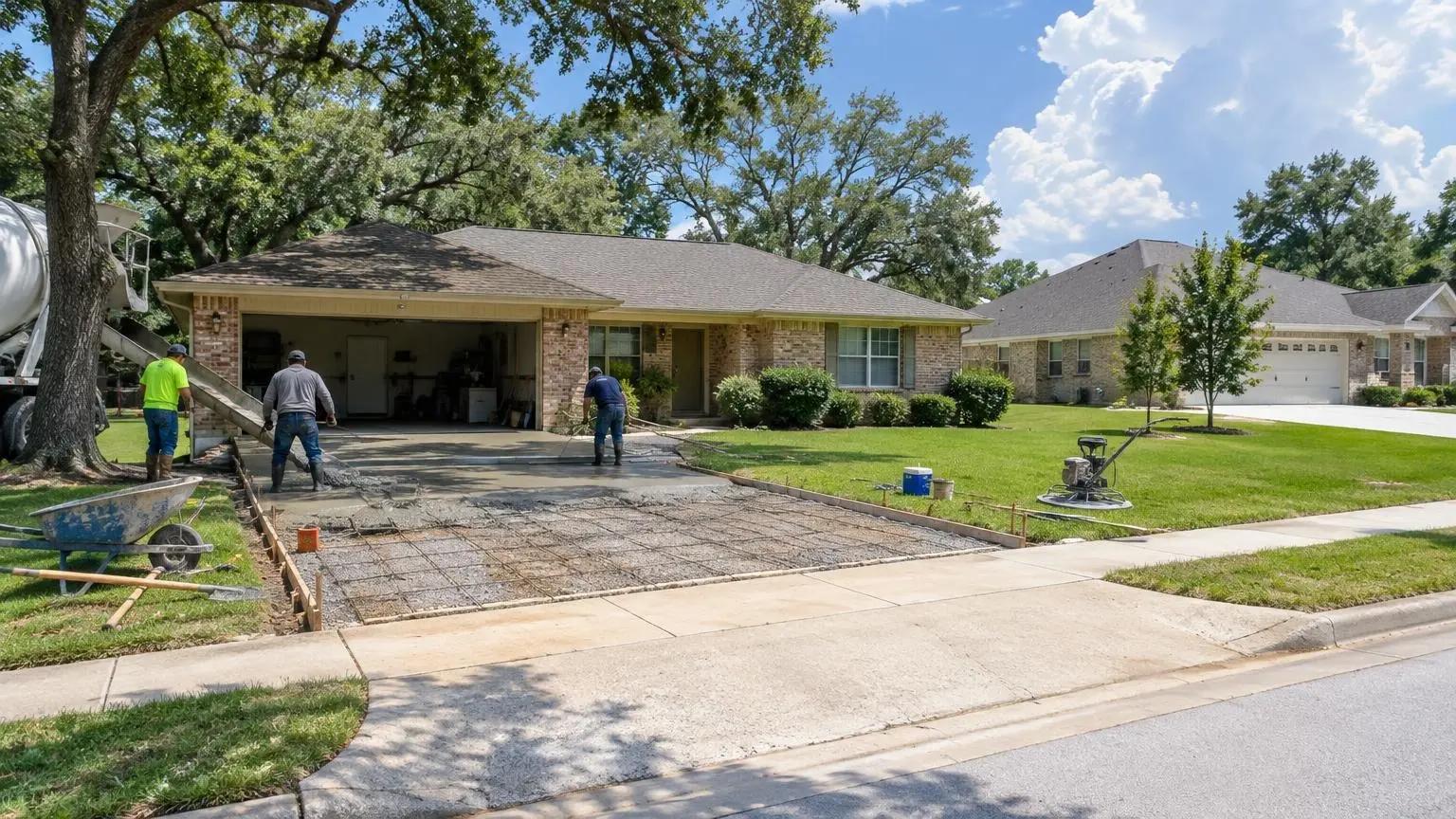
Concrete for an Older City
Bryan is older than its neighbor to the south, and as concrete contractors we plan Bryan jobs with that age in mind. The town was platted in 1859 on land William Joel Bryan donated to the Houston and Texas Central Railroad, became the Brazos County seat in 1866 and incorporated in 1871. Concrete in Bryan ranges from century-old walks in front of historic houses to driveways poured last year.
Building on what came before
The Handbook of Texas lists Bryan at 11,842 people in 1940, 27,542 in 1960, 44,337 in 1980 and 65,660 in 2000. The 2020 census counted 83,980. Each of those growth periods left its own kind of concrete behind.
In the oldest parts of town, many turn-of-the-century homes still stand, and some are listed on the National Register of Historic Places or are registered Texas historical landmarks. Walks and steps at those homes are often narrow, thin and patched many times. Replacing them calls for care: matching the width, keeping the look of the street, and protecting old trees whose roots run under the slab.
The mid-century neighborhoods that filled in from the 1940s through the 1980s hold driveways that are now decades old. At that age, joints tend to widen, panels drop, and a drive sized for a 1950s sedan can be tight for a modern pickup. Widening a driveway or adding a parking pad beside it suits many of these lots.
Drainage comes first
The City of Bryan's lot grading guidelines put the goal in plain words: immediate diversion of water away from buildings and off the site. The same guidelines say runoff must not be concentrated onto neighboring properties, and they cap lot slopes at 10 percent in normal conditions. A new patio or driveway changes how water moves across a lot, so we set slopes before we pour, not after.
What that looks like on a job:
- Patios pitched away from the house, usually about an eighth to a quarter inch per foot.
- Driveways that shed water to the street, not toward the garage or a neighbor's yard.
- Walkways set slightly above the grass so they do not become a channel.
- Downspouts turned out away from new slab edges so the base stays firm.
Heat, rain and rare cold
Wikipedia's climate data for Bryan gives a mean August high of 96.2 degrees and about 40 inches of rain a year. Snow and ice are rare, but the record low is minus 3 degrees. We plan pours for the cool part of the day in summer, cure slabs with water or a curing compound, and use air-entrained mixes so the occasional freeze does not flake the surface.
Matching old and new in Bryan
Because the Handbook of Texas notes that some of Bryan's turn-of-the-century homes are on the National Register or are registered Texas historical landmarks, a replacement walk in front of one of them deserves more thought than a subdivision sidewalk. We measure the old width and joint spacing before demolition so the new walk can repeat them, and we keep finishes plain: a light broom with tooled edges rather than a bold stamped pattern. Stamped concrete and colored finishes fit better on back patios and pool areas, out of view from the street.
At the other end of town, homes from the city's fastest growth years, when the population rose from 27,542 in 1960 to 65,660 in 2000, tend to need driveway replacement, widening and patio additions. Newer houses often need only sealing, crack repair or a patio extension.
Before we pour near the street, we check what the City of Bryan's Development Services requires for your address. Building permits and inspections run through that department.
What to Know in Bryan
- Founding. Platted in 1859 on land donated by William Joel Bryan, county seat from 1866 and incorporated in 1871.
- Historic homes. Many turn-of-the-century homes remain, and some are on the National Register of Historic Places.
- Lot grading rule. City guidelines call for immediate diversion of water away from buildings and cap lot slopes at 10 percent in normal conditions.
- Climate. Mean August high of 96.2 degrees and about 40 inches of rain a year; record low of minus 3 degrees.
- Growth. Population rose from 27,542 in 1960 to 65,660 in 2000 and 83,980 in the 2020 census.
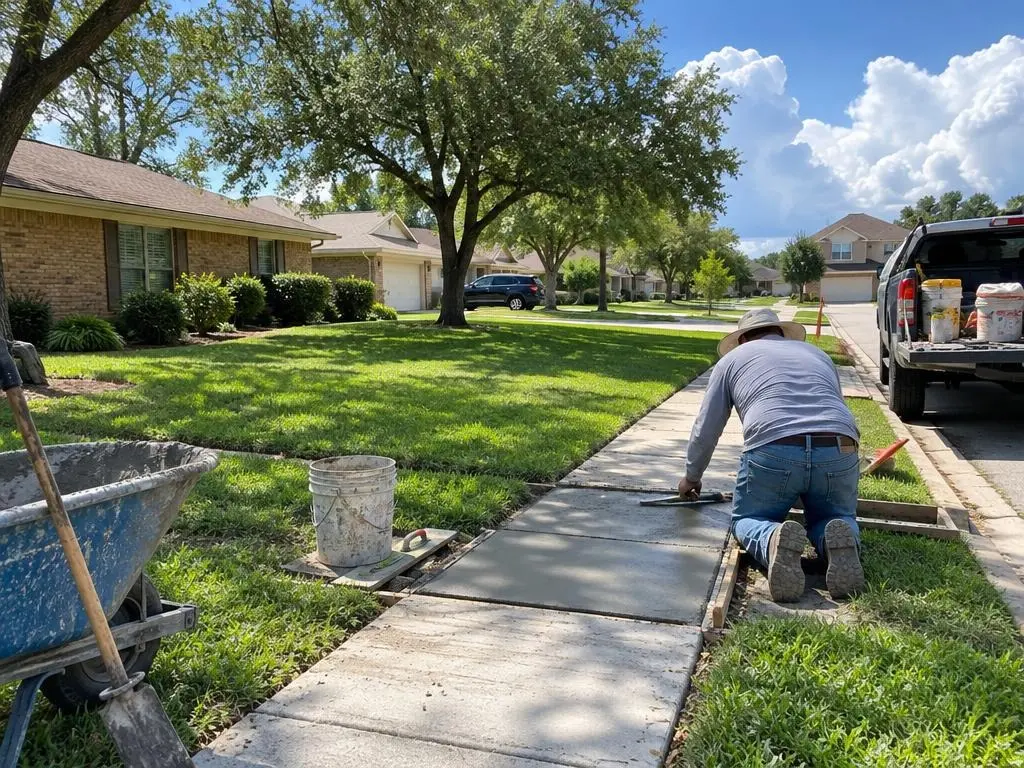
Our Services in Bryan, TX
Bryan Questions
My house in Bryan is old. Can you replace the front walk without changing its look?
Yes. We measure the existing width and layout, match the finish as closely as we can, and work carefully around mature tree roots. If the home is a registered landmark, ask the city about any rules before we start.
Water pools on my patio after a storm. Can that be fixed?
Sometimes the patio can be ground or overlaid, but if it was poured flat or sloping toward the house, replacing it with the right pitch is the lasting fix. Bryan's grading guidelines also call for water to move away from buildings.
Can you widen my driveway?
Yes. We saw-cut a clean edge, form the new section, pin it to the old slab with rebar dowels and match the finish. We also check the curb cut and any city requirements for the change.
Free Estimates in Bryan, TX
Free estimates for Bryan homes, old and new.
Concrete Contractors Near Bryan
- Concrete Contractors in College Station, TX
- Concrete Contractors in Wellborn, TX
- Concrete Contractors in Kurten, TX
- Concrete Contractors in Wixon Valley, TX
- Concrete Contractors in Navasota, TX
- Concrete Contractors in Hearne, TX
- Concrete Contractors in Caldwell, TX
- Concrete Contractors in Millican, TX
- Concrete Contractors in Snook, TX
- Concrete Contractors in Anderson, TX
- Concrete Contractors in Calvert, TX
- Concrete Contractors in Franklin, TX
- Concrete Contractors in Somerville, TX
- Concrete Contractors in Iola, TX
- Concrete Contractors in Mumford, TX
- Concrete Contractors in Smetana, TX
- Concrete Contractors in Edge, TX
- Concrete Contractors in Brenham, TX
- Concrete Contractors in Benchley, TX