
Driveways, patios and flatwork in the Brazos Valley
Concrete Contractors in College Station, TX
Residential concrete poured for 96-degree Augusts and heavy spring rain, starting with a compacted base and a written price.
- Free visit to your property: we measure and check where water runs
- A written, line-item price before any concrete is ordered
- College Station right-of-way permits and steel inspections built into the schedule
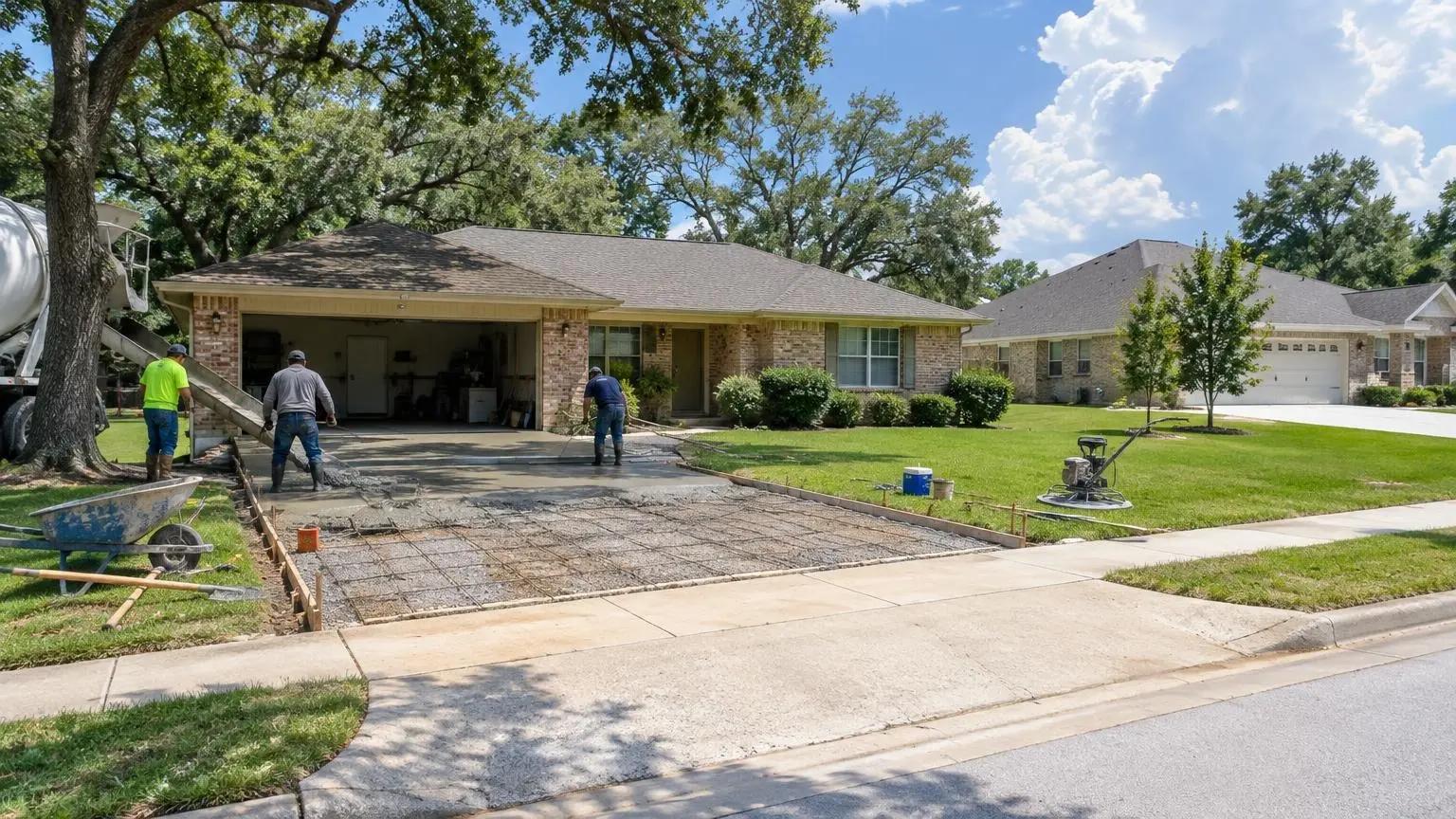
Concrete Work Planned for College Station Weather and Ground
We are concrete contractors in College Station, Texas, and we pour and repair driveways, patios, stamped concrete, sidewalks and slabs for homes across the city and the rest of the Brazos Valley. College Station sits in Brazos County about 83 miles northwest of Houston and 87 miles east-northeast of Austin, and it shares a metro area with Bryan. The weather and the ground here shape how concrete should be placed, so every job starts with a site visit, a look at drainage and a written quote.
Heat is the first problem
Wikipedia's climate table for College Station shows average highs of 92 degrees in June, 95 in July and almost 97 in August, with a record of 112. Concrete needs water to gain strength, and on a hot, windy afternoon the surface can dry before the slab underneath has set. That leads to surface cracking, dusting and a weaker top layer. In summer we book pours for the first hours of daylight, wet the subgrade beforehand, and keep the fresh slab damp or under curing compound for its first days. Timing a pour around the heat is one of the simplest ways to get a driveway that lasts.
Rain comes in bursts
The city averages about 41.75 inches of rain a year. That is more than many people expect from Central Texas, and it often comes in heavy storms. Water that runs off a roof or a neighbor's yard and soaks the ground under a slab is the most common reason concrete settles or cracks. We set slopes so water drains away from the house, and we look at gutters, downspouts and low spots before we pour. A new driveway on a soft, wet base will not stay flat no matter how well it is finished.
Clay, sand and moving ground
The Texas State Historical Association describes Brazos County soils as alluvial to sandy, with the northern third of the county in the Blackland Prairie and the rest in the Post Oak Savannah. The Blackland Prairie is known for dark, clayey soils, and clay swells when it gets wet and shrinks in drought. That movement is hard on flatwork. The soil is what it is; what we control is what sits between it and the concrete. That means removing soft or organic material, building a compacted base, using rebar where loads and soil call for it, and cutting joints so any crack lands where we planned it.
Older slabs in established neighborhoods
College Station grew quickly in the 1970s and 1980s. Point2Homes' summary of American Community Survey data puts 12.1% of College Station housing in the 1970s and 18.7% in the 1980s, so close to a third of the housing stock has concrete that is more than 35 years old. Those driveways and walks often have heaved panels, wide cracks and sunken sections near trees. Another 44.5% of homes went up between 2000 and 2019, and those newer slabs tend to need sealing, crack repair or a patio extension more than full replacement. The city's median year built is 1999.
Permits and the right-of-way
The City of College Station requires a permit to build or change a drive approach or curb cut in the street right-of-way. The city's driveway page also says a permit is still needed if added paving tops 120 square feet, even when the curb cut stays the same. Residential driveway permits are filed through the city's eTRAKiT permitting site, and Planning & Development Services inspects the reinforcement before the concrete is poured. We plan that inspection into the schedule so your pour is not delayed.
Services
- Driveways: new pours, tear-out and replacement, added width and street approaches
- Patios: broom, smooth-trowel or exposed aggregate surfaces, add-ons to existing slabs, grill and spa pads
- Stamped concrete: pressed patterns with color for patios, entries and drive borders
- Sidewalks and walkways: entry walks, side-yard paths, steps and street-side sidewalk panels
- Slabs: pads for storage buildings, shops, RVs, condensers and garage floors
- Repair: crack sealing, lifting sunken panels, resurfacing and sealer
Rentals and owner-occupied homes
According to the Census Bureau, about 35% of College Station homes are owner-occupied, a low share that reflects the large student population at Texas A&M. Landlords and property managers often need a broken walk or a trip hazard fixed between leases, while owner-occupants tend to plan bigger projects. Both get the same written quote, the same base prep and the same curing schedule.
From first call to first seal
The estimate visit comes first: measurements, a look at drainage and a talk about finishes. Then comes a line-item quote. Work days usually go in this order: break out any old concrete, grade and compact, set forms and steel, then pour, finish, saw joints and start curing. For driveway timing, HomeGuide's guidance is a week or more before cars and about 30 days before heavy trucks or the first coat of sealer. Your schedule comes in writing. Call (979) 406-7552 or send an estimate request.
Common Questions
How much do concrete contractors charge in College Station?
HomeGuide's national figures are a fair place to start: roughly $6 to $15 a square foot for an installed driveway and $4 to $12 for a plain patio, more for stamped work. Tear-out, grading, steel and decorative finishes move the number, so the price you can count on is the written one we give after a site visit.
What is the average price of concrete in Texas?
Our cost sources publish national numbers, not Texas-only ones. In HomeGuide's tables a 20 by 20 foot driveway comes to about $2,400 to $6,000 and a 12 by 12 foot plain patio to about $600 to $1,700. Access, demolition, base work and finish decide where a College Station job lands.
Does College Station require a driveway permit?
For drive approaches and curb cuts in the street right-of-way, yes. The city's driveway and curb cut page also requires a permit when added paving exceeds 120 square feet, and Planning & Development Services inspects the steel before concrete is placed. We confirm what your job needs and build the inspection into the schedule.
Is summer a bad time to pour?
Not if the pour is planned for it. Hot-weather pours start early in the morning, the subgrade is wetted first so dry ground does not rob the mix of water, and the surface is protected with water or curing compound afterward. Most heat-related surface cracking comes from afternoon pours left to dry in the sun.
What makes concrete crack in the Brazos Valley?
Every slab shrinks a little while it cures, which is why control joints are cut: they give that shrinkage a straight line to follow. Larger cracks and dropped panels usually trace back to the ground, such as a base that was soft or wet, clay that swells and shrinks, or roots. Base prep and drainage head off most of it.
When can I park on a new driveway?
HomeGuide's guidance is walking after 24 to 48 hours, passenger vehicles after at least a week, and heavy trucks only after the full cure of about 30 days. Your pour gets its own dates in writing.
Is my old driveway worth repairing?
If the slab is still in one piece and the cracks are narrow, repair, lifting or resurfacing usually costs less. HomeGuide points toward replacement once cracks are wider than about 1/4 inch, or when the surface is crumbling or badly spalled. We give you our read after seeing it.
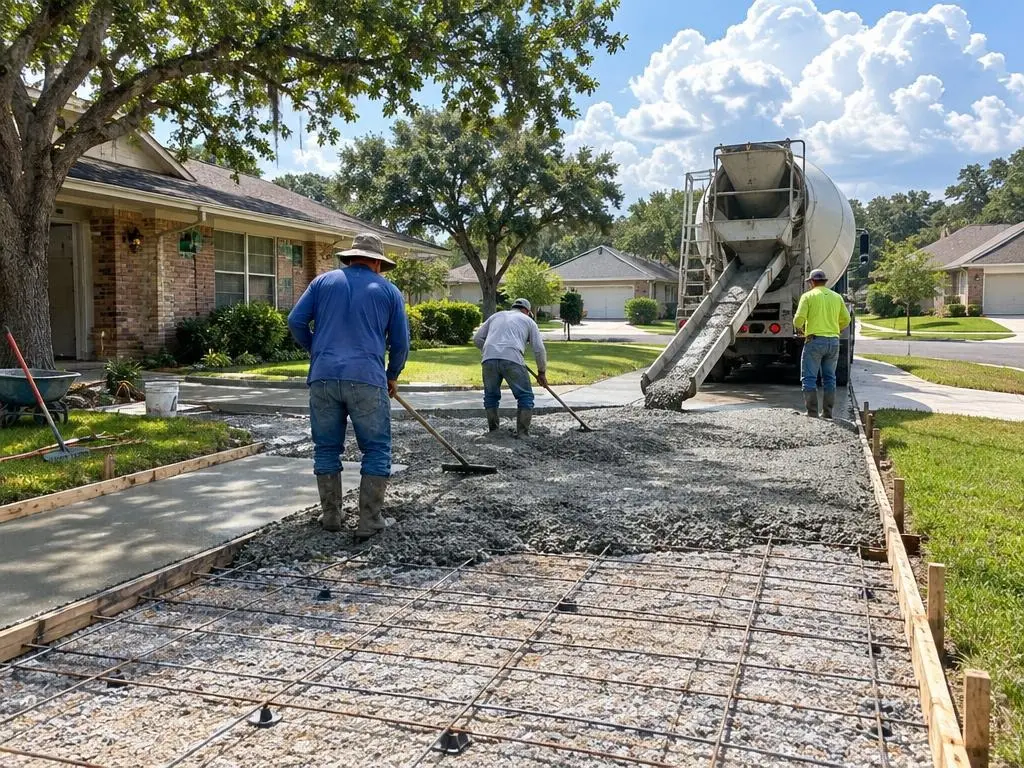
Our Concrete Services
From 1980s driveways that have heaved to new patios behind 2010s homes, these are the six kinds of work we take on.
Concrete Driveways
New and replacement driveways on a compacted base, with steel, drainage slope and curing timed around summer heat.
Learn more →Concrete Patios
Backyard patios, extensions and hot tub pads, sloped to shed heavy rain and finished for bare feet in summer.
Learn more →Stamped Concrete
Patterned and colored concrete that looks like stone, brick or wood, sealed to hold its color in strong Texas sun.
Learn more →Sidewalks & Walkways
Front walks, side paths, steps and public sidewalk sections, with lifted and cracked panels replaced to remove trip hazards.
Learn more →Concrete Slabs
Slabs for sheds, workshops, RVs, AC units and garage floors, sized and reinforced for what will sit on them.
Learn more →Concrete Repair
Crack repair, leveling of sunken slabs, resurfacing and sealing, with honest advice when replacement makes more sense.
Learn more →Where We Work
College Station is home base, including Wellborn, which the city annexed in 2011. Next door is Bryan. Beyond the two cities we cover Kurten, Wixon Valley, Smetana, Edge, Millican and Benchley in Brazos County and along US 190; Snook, Caldwell and Somerville in Burleson County; Hearne, Calvert, Franklin and Mumford in Robertson County; Navasota, Anderson and Iola in Grimes County; and Brenham in Washington County. Conditions change from place to place. Older parts of College Station and Bryan have decades-old driveways and walks that need repair or replacement. Newer subdivisions have younger slabs that mostly need patios, extensions and sealing. Rural properties outside the cities often need shop slabs, RV pads and long driveways. Each town page lists sourced facts about the ground, weather and housing there.
- Concrete Contractors in College Station, TX
- Concrete Contractors in Bryan, TX
- Concrete Contractors in Wellborn, TX
- Concrete Contractors in Kurten, TX
- Concrete Contractors in Wixon Valley, TX
- Concrete Contractors in Navasota, TX
- Concrete Contractors in Hearne, TX
- Concrete Contractors in Caldwell, TX
- Concrete Contractors in Millican, TX
- Concrete Contractors in Snook, TX
- Concrete Contractors in Anderson, TX
- Concrete Contractors in Calvert, TX
- Concrete Contractors in Franklin, TX
- Concrete Contractors in Somerville, TX
- Concrete Contractors in Iola, TX
- Concrete Contractors in Mumford, TX
- Concrete Contractors in Smetana, TX
- Concrete Contractors in Edge, TX
- Concrete Contractors in Brenham, TX
- Concrete Contractors in Benchley, TX
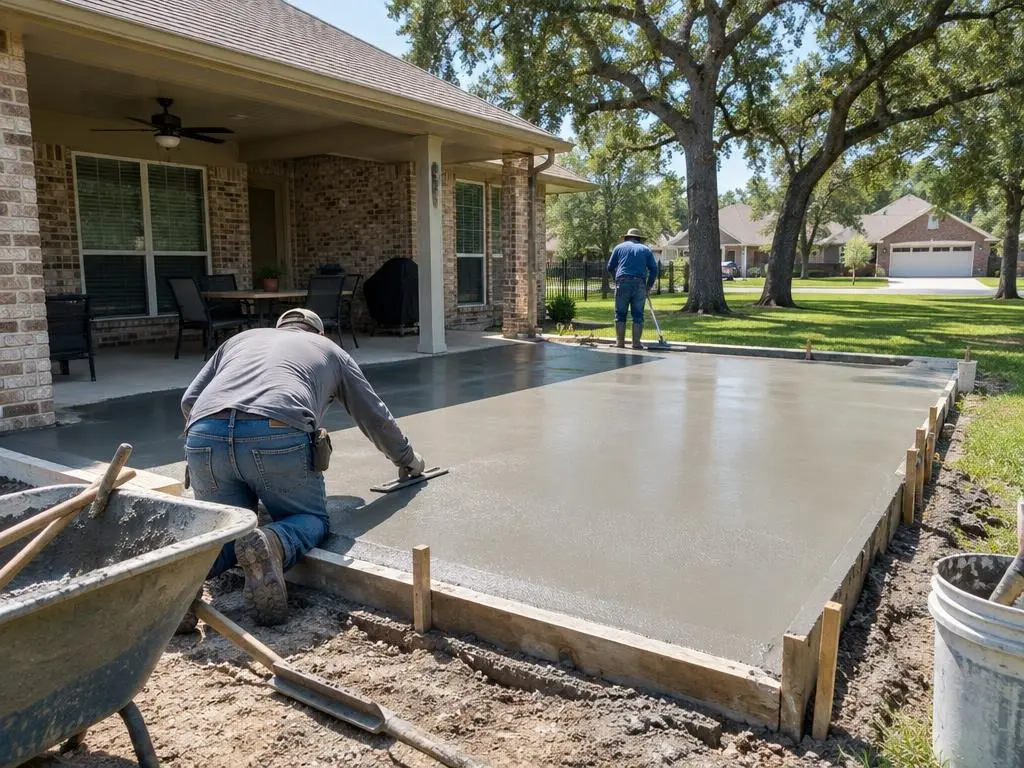
Why Homeowners Call College Station Concrete Contractor Pros
Base before finish
Soft soil is dug out and the base is compacted before forms go in. Most settling and cracking starts below the slab.
Pours timed for the heat
Summer pours start early, and new concrete is kept moist while it cures so the surface does not dry out and crack.
Permits handled
If the job reaches the curb or street, we check the city's permit rules and schedule the reinforcement inspection before the pour.
One written price
Tear-out, base, depth, steel, finish and sealer are each listed. Nothing changes without a written price you approve.
Request a Concrete Estimate
We come to College Station, Bryan and nearby Brazos Valley towns to measure and price your job at no charge.